 PQC InfoHub
Tencent Cloud Post-Quantum Cryptography Migration Roadmap
Tencent Cloud began migrating to post-quantum cryptography (PQC) in 2026. We aim to provide post-quantum protection across Tencent Cloud products and services by 2029, helping customers safeguard the long-term confidentiality of their data and maintain business continuity.
On this page
Tencent Cloud Post-Quantum Cryptography Migration Roadmap
Advances in quantum computing are changing the security assumptions underpinning modern cryptography. Once sufficiently capable quantum computers become available, widely used public-key algorithms—including RSA, ECC, and SM2—will no longer be secure. This will affect encrypted communications, authentication, and digital signatures across cloud services.
Tencent Cloud began migrating to post-quantum cryptography (PQC) in 2026. We aim to provide post-quantum protection across Tencent Cloud products and services by 2029, helping customers safeguard the long-term confidentiality of their data and maintain business continuity.
The timelines, milestones, and technical approaches in this document reflect our plans as of the publication date. They may change as standards and regulatory requirements evolve, technologies and ecosystems mature, or third-party dependencies change. Nothing in this document constitutes a commitment to deliver a particular feature by a particular date, or a service-level agreement (SLA). For the latest scope, configuration options, and release timing, refer to the relevant product documentation, service announcements, and customer agreements.
Threat Model
Quantum computing poses different levels of risk to today’s cryptographic systems. A sufficiently capable quantum computer could break public-key cryptosystems based on RSA and elliptic curves. It would also reduce the effective key strength of symmetric algorithms such as AES by approximately half.
The risks fall into three broad categories:
- Transport security (high priority): TLS, SSH, and similar protocols use asymmetric cryptography to establish session keys. Attackers can capture and retain handshake data and ciphertext today, then decrypt them once sufficiently capable quantum computers become available. This is known as a Store Now, Decrypt Later (SNDL) attack. The longer data must remain confidential, the greater the risk of retrospective decryption, making transport security the most urgent priority.
- Authentication security (medium priority): An attacker with a sufficiently capable quantum computer could derive private keys, compromising the unforgeability and non-repudiation of digital signatures. Because such attacks cannot be carried out until practical quantum computers exist, they are less immediate than the threat to data in transit.
- Data-at-rest security (low priority): Data at rest is generally encrypted with symmetric algorithms. Quantum attacks reduce their effective security strength rather than breaking them outright, and longer keys can mitigate the risk. This is therefore the lowest-priority category.
Tencent Cloud PQC Migration Plan
To minimize migration costs and operational disruption for customers, Tencent Cloud will first modernize the shared cryptographic infrastructure and ingress platforms used by multiple services. This platform-led approach will extend post-quantum protection consistently across those services.
Migration Principles
- Align with international and Chinese standards: Tencent Cloud will base its algorithm and protocol migration on applicable international and Chinese PQC standards and technical specifications. The roadmap covers both internationally standardized algorithms and Chinese commercial cryptographic algorithms. For the international standards track, we will prioritize standardized post-quantum algorithms such as ML-KEM, ML-DSA, and SLH-DSA, and track their evolution. At the protocol layer, we will follow relevant IETF specifications. Chinese PQC algorithm standards have not yet been published, so during the transition Tencent Cloud will use hybrid designs that combine existing Chinese commercial cryptographic algorithms with post-quantum algorithms. We will monitor standards development in China and align our implementations once those standards are published.
- Use hybrid post-quantum cryptography: For transport security and authentication, Tencent Cloud will combine classical and post-quantum cryptography through hybrid key agreement and hybrid certificate mechanisms. If a post-quantum algorithm proves vulnerable to classical attacks before cryptographically relevant quantum computers become available, the classical component will continue to provide protection. Conversely, once such quantum computers become available, the post-quantum component can protect the confidentiality of communications even if the classical algorithm is broken. Coverage will expand as standards mature, client support grows, and compatible deployment patterns are validated, preserving interoperability across systems, clients, and ecosystem partners.
- Build cryptographic agility: Cryptographic agility is the ability to replace or adapt cryptographic algorithms and rotate keys with minimal changes to application code and without disrupting ongoing operations. PQC is still evolving, and performance improvements, new security findings, compliance requirements, or differences among national and regional cryptographic standards may all require algorithm replacement or key rotation. Tencent Cloud will provide unified, configurable, and observable cryptographic capabilities that allow cloud services to replace algorithms and rotate keys smoothly, reducing the operational impact of future changes in standards and security requirements.
Migration Roadmap
Tencent Cloud will establish foundational capabilities, address the highest risks first, and broaden service coverage over time. We will prioritize cryptographic infrastructure and ingress platforms shared by multiple cloud services, allowing common platform upgrades to extend post-quantum protection across those services. Cloud services that operate their own ingress layer, protocol stack, or root of trust will require service-specific integration and validation.
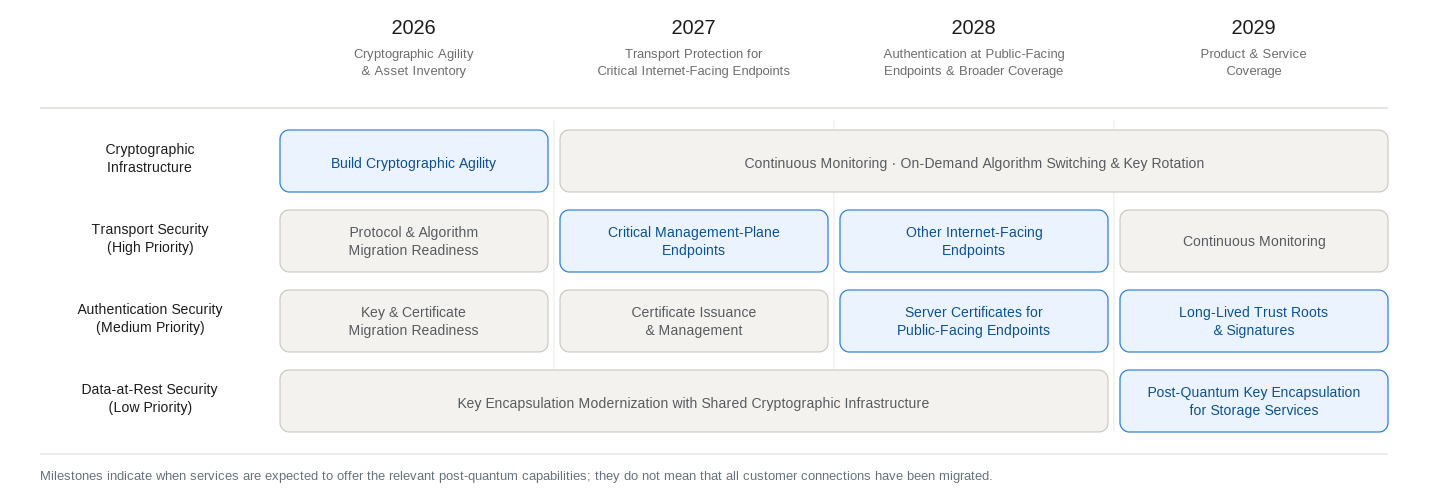
Workstreams covering cryptographic infrastructure, transport security, authentication, and data-at-rest protection will run in parallel. The annual targets below mark the main milestones we expect to reach; they are not sequential phases. The initial public draft of NIST IR 8547 proposes deprecating certain quantum-vulnerable public-key algorithms after 2030 and disallowing all such algorithms after 2035. Tencent Cloud aims to extend PQC capabilities across its products and services before the deprecation period begins. The pace of migration will be reviewed as quantum computing advances and standards and the broader ecosystem mature. Implementation will also account for applicable legal, policy, and compliance requirements in each country and region.
- 2026: Cryptographic agility and asset inventory. Building on cryptographic infrastructure such as Key Management Service (KMS) and Cloud Hardware Security Module (CloudHSM), Tencent Cloud will add support for algorithm replacement, key rotation, and usage monitoring. In parallel, we will inventory the keys, certificates, cryptographic algorithms, and protocols used across cloud services, identifying migration targets and their dependencies. We will also begin migrating long-lived assets that are difficult to replace quickly, including root certificates, firmware signatures, and hardware roots of trust.
- 2027: Transport protection for critical internet-facing endpoints. Internet-facing traffic presents the most urgent SNDL risk. Tencent Cloud will therefore introduce post-quantum/traditional hybrid key agreement for TLS 1.3 at management-plane endpoints and internet-facing ingress services, including Tencent Cloud EdgeOne and Cloud Load Balancer (CLB). The rollout will support the hybrid key agreement mechanisms defined in RFC 10024, including X25519MLKEM768, to protect the long-term confidentiality of data in transit. In parallel, we will upgrade the supporting infrastructure for SSL/TLS certificates, digital signatures, and key management, laying a shared foundation for the authentication migration that follows.
- 2028: Authentication at public-facing endpoints and broader coverage. With transport protection available at critical internet-facing endpoints, Tencent Cloud will begin adopting hybrid post-quantum certificates at public-facing endpoints as the CA/Browser Forum Baseline Requirements for publicly trusted TLS server certificates evolve and mainstream client support becomes available. In parallel, we will upgrade certificate issuance, lifecycle management, and validation capabilities to protect server authentication. We will also extend post-quantum protection to internet-facing endpoints managed independently by individual cloud services.
- 2029: Coverage across products and services. Tencent Cloud will complete the migration of cloud services and communication protocols not covered in earlier phases, bringing post-quantum protection to data in transit, authentication, digital signatures, and key management. We will continue the longer-term migration of root certificates, certificate chains, code and firmware signing, device identities, and hardware roots of trust. For storage services, we will complete support for post-quantum key encapsulation while preserving the ability to decrypt existing ciphertext. Together, these steps will extend post-quantum protection across Tencent Cloud products and services.
Ecosystem Coordination
PQC migration spans cryptographic standards and application profiles, software and hardware supply chains, cloud platforms, and customer applications. The protection customers ultimately receive depends not only on Tencent Cloud’s server-side support, but also on end-to-end interoperability across clients, origin servers, network appliances, and third-party components. As we migrate our own services, Tencent Cloud will work with standards bodies, vendors, ecosystem partners, and customers to put these protections into practice.
- Evolving standards and policies: PQC algorithms, communication protocols, and the publicly trusted certificate ecosystem are still evolving, while legal, policy, and compliance requirements vary by country and region. Tencent Cloud will align its migration with relevant standards, technical specifications, and applicable regulations.
- Upstream ecosystem support: PQC adoption depends on support across the software and hardware ecosystem, including cryptographic libraries, operating systems, browsers, hardware modules, and endpoint devices. Tencent Cloud will continue to track support status and applicable versions, and will work with vendors and ecosystem partners to validate compatibility and interoperability.
- Coordination with customer applications: Customers can start by adopting Tencent Cloud’s post-quantum protection for ingress traffic and connections to origin servers. By upgrading clients, applications, and third-party cryptographic dependencies, and validating compatibility, they can progressively extend post-quantum protection across the end-to-end service path.
Customer Migration Approach
As PQC support rolls out across Tencent Cloud, customers can use these capabilities to migrate in stages based on their risk profile and cryptographic dependencies.
- Identify risks and inventory assets: Inventory the algorithms, protocols, keys, certificates, and cryptographic components used across each end-to-end service path, including the application itself, its supply chain, and its runtime environment. For each item, record the owner, required confidentiality lifetime, threat category, and exposure.
- Prioritize the migration: Set migration priorities based on data sensitivity and confidentiality lifetime, exposure, business criticality, and upgrade complexity. Prioritize internet-facing traffic and traffic crossing network or trust boundaries when they carry sensitive data with long confidentiality requirements, especially for critical workloads.
- Migrate: Tencent Cloud will deliver PQC through managed, automated mechanisms designed to remain compatible with existing workloads, minimizing customer-side changes. Where Tencent Cloud provides managed cryptographic capabilities, customers can adopt PQC as the relevant services are upgraded—across service endpoints, network connections, certificate management, and key management—and then complete any product-specific configuration and compatibility testing. Cryptographic dependencies embedded in customer applications or third-party components may require updates to custom protocols, cryptographic libraries, and private PKI or trust frameworks as standards and ecosystem support mature. Consolidating cryptographic libraries and centralizing key management will also improve cryptographic agility for future algorithm changes.
- Validate the migration: Test each migrated end-to-end service path to confirm that post-quantum protection is active and normal operations are unaffected, then roll out the changes more broadly.
Long-Term Governance
PQC migration is an ongoing program, not a one-time replacement. After each phase, Tencent Cloud will maintain cryptographic agility, progressively retire quantum-vulnerable algorithms, and keep customers informed as standards, ecosystem support, and service capabilities evolve.
- Retire vulnerable algorithms: Even after a system supports PQC, continuing to permit key-agreement methods or certificates that lack a post-quantum component leaves the system vulnerable to downgrade attacks that force it back to quantum-vulnerable algorithms. These legacy options must therefore be phased out. Once they have been removed, credentials previously transmitted over vulnerable channels—including passwords and access tokens—should be rotated.
- Continuous monitoring and updates: Tencent Cloud will monitor the use of cryptographic algorithms across its services and identify quantum-vulnerable algorithms introduced through new systems or dependencies. When standards, regulations, or the security of an algorithm changes, we will promptly update cryptographic configurations and migration plans.
- Industry information sharing: Tencent Post-Quantum Cryptography InfoHub tracks developments across the PQC ecosystem and provides updates on cryptographic standards, policies and regulations, migration guidance, ecosystem support, quantum computing, and industry practices. It helps organizations and developers understand, plan for, and deploy quantum-resistant cryptography.