 PQC InfoHub
PrimerHow Far Are Quantum Computers from Breaking RSA-2048?Part 2 of 3
How Are Quantum Computers Built?
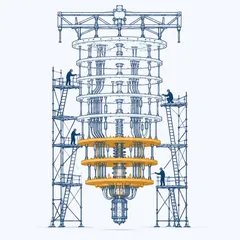
Superconducting qubits, the approach most likely to reach practical scale, use Josephson junctions and depend on a complete chain of chip, dilution refrigeration, precise microwave control and real-time error correction. This integration from physics to system is why superconducting machines lead in scalability and engineering.
On this page
Physical Implementations of Qubits
Qubits are essentially constructed from states in the physical world. Depending on the source of physical states used, quantum computer construction methods can be divided into two categories:
One approach uses microscopic particles—ions, photons, or atoms—computing by manipulating and measuring their quantum states. Identical particles have identical physical properties, enabling multi‑particle interference and entanglement. In well‑isolated settings, they offer high state purity, low error rates, and long coherence times. However, precise control remains challenging, and operations are typically slow.
Another approach uses artificial structures—such as superconducting circuits and quantum dots—where macroscopic circuit behavior encodes quantum states. These qubits are easier to fabricate, operate, and scale with modern semiconductor technology. The challenge is materials defects: unlike natural particles, each device has small variations that introduce noise and errors, reducing state stability. Even so, these qubits are generally easier to measure and control and are more tractable from an engineering standpoint.
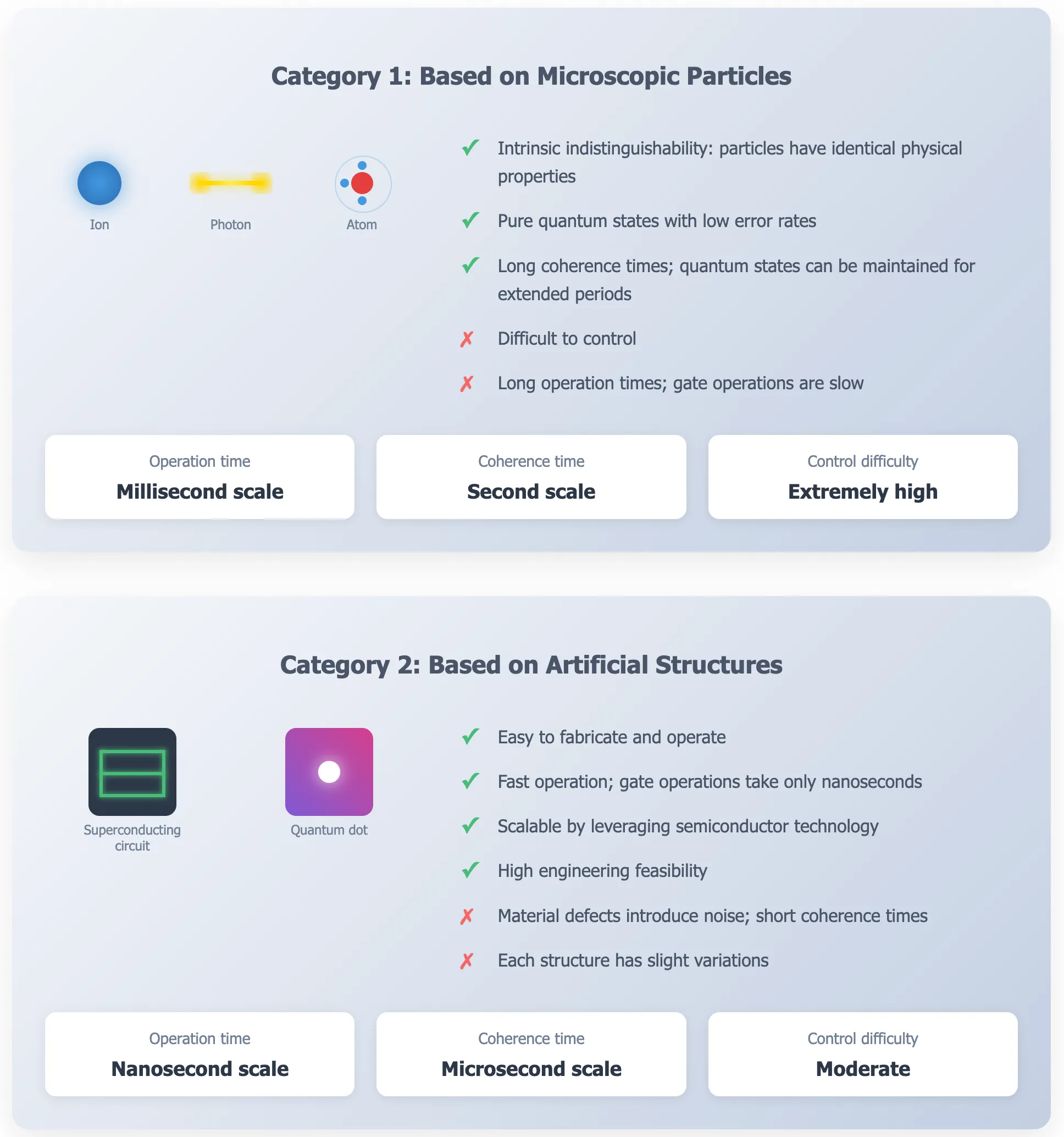 Figure: Two main approaches to building quantum computers.
Currently, superconducting quantum computing is considered one of the most mature and promising directions because it shows excellent performance in operating speed and integration, and its technological development is relatively rapid. Therefore, we will focus on introducing superconducting quantum computers as an example.
Construction Principles of Superconducting Qubits
In superconducting quantum computers, the qubit state comes from the energy levels of a Josephson junction, the core device consisting of two superconductors separated by a nanometer‑scale insulator. Energy levels are the allowed energies of a system—discrete and fixed. The lowest level E₀ is the ground state; higher levels (such as E₁) are excited states. The qubit’s logical 0 and 1 correspond to E₀ and the first excited state E₁, respectively.
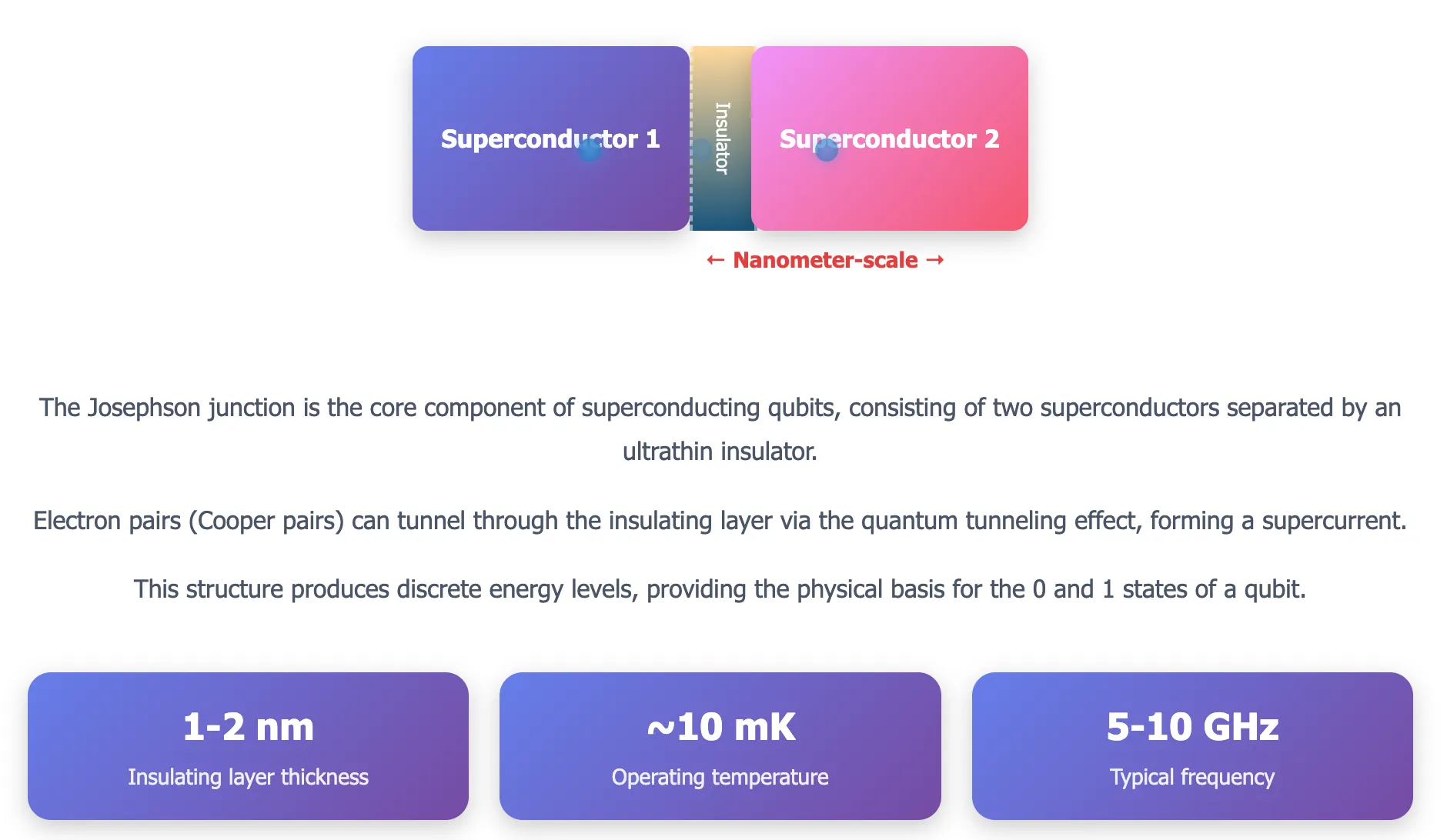 Figure: Josephson junction basic structure.
By applying microwaves at specific frequencies to the junction, we inject energy and drive transitions between E₀ and E₁ (much like a microwave oven drives molecular rotation with resonant microwaves). Precise control over these transitions underpins quantum logic. A “half pulse” can leave the qubit in a superposition of E₀ and E₁. In short, we steer qubit states by tuning the microwave frequency, amplitude, and duration.
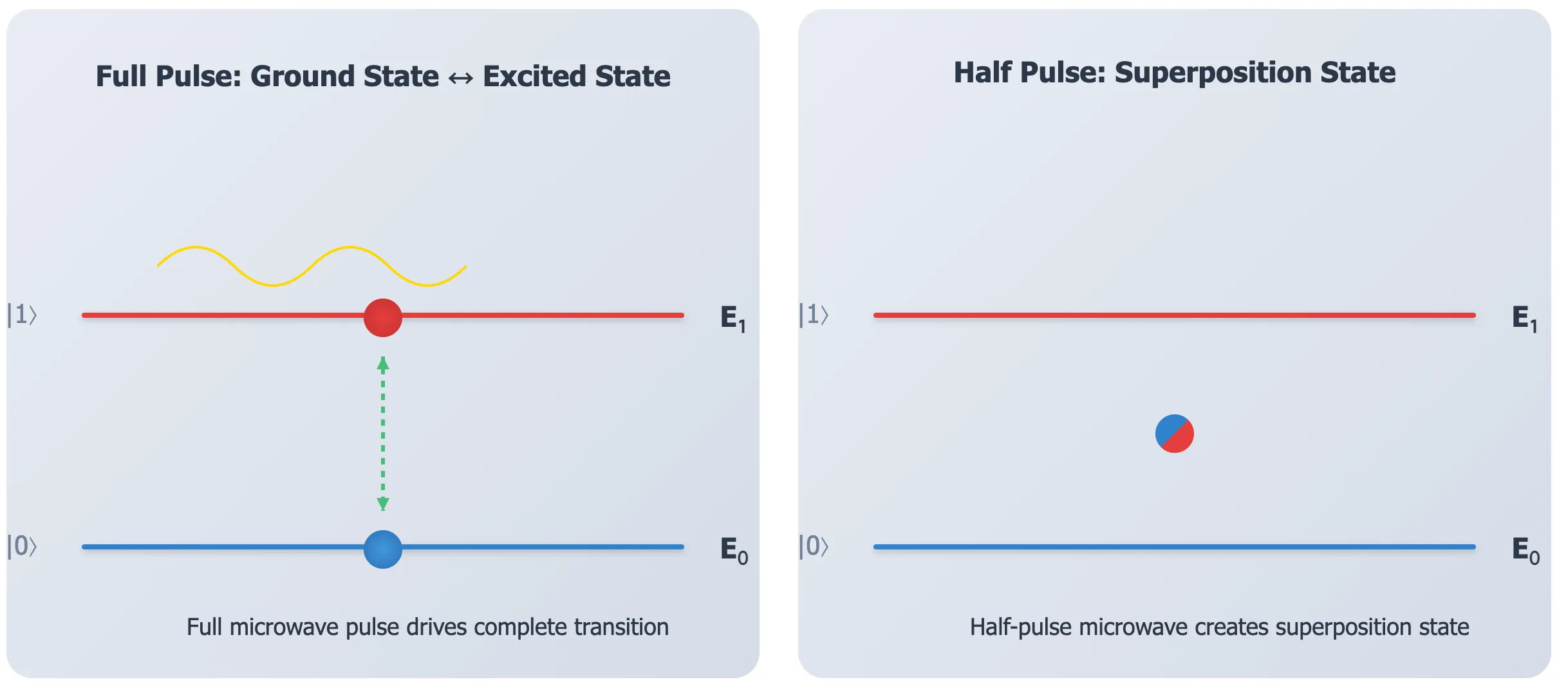 Figure: Energy‑level control of a superconducting qubit. A full pulse drives |0⟩→|1⟩; a half pulse creates a superposition.
Since the energy difference between the energy levels of superconducting qubits is extremely small, quantum states are extremely sensitive to disturbances from the external environment. Even very slight thermal noise, electromagnetic waves, or radiation interference can cause decoherence of quantum states (i.e., destruction of quantum states), preventing qubits from working properly. To reduce these interferences, superconducting quantum computers must operate in extremely low-temperature environments close to absolute zero (about 10 millikelvin (mK), only 0.01 degrees higher than absolute zero -273.15 °C, already the lowest continuous temperature humans can achieve), and use special materials and carefully designed shielding, filtering, and attenuation measures in connecting circuits to maintain energy level stability and manipulation precision as much as possible.
From Single Qubit to the “System Architecture” of Superconducting Quantum Computing
To build a practically operational superconducting quantum computer, not only qubits themselves are needed, but also a complete support system: refrigeration and shielding systems to protect quantum states, control systems to manipulate qubits, and error correction systems to correct errors in quantum systems in real time. Among these systems, the error correction system is particularly critical. This is because the reliability of quantum computing faces two fundamental challenges:
- Insufficient coherence time: That is, the duration a qubit can maintain quantum properties such as superposition and entanglement without being destroyed by the environment. Therefore, to use qubits for computation, the coherence time of qubits must be longer than the time required for computation. Although measures such as refrigeration and shielding can extend coherence time, they are still difficult to meet the demands of complex operations.
- Insufficient gate fidelity: Quantum gates are not fixed gate circuits like classical bits, but are implemented through real-time manipulation by external control signals. The closeness of the actual effect of quantum gate operations to the ideal effect is the gate fidelity. However, even if the fidelity of a single gate operation is very high (such as 99.9%), after performing thousands or even millions of operations, errors will continue to accumulate, ultimately destroying computational results.
Next, we will introduce each core component of superconducting quantum computers in detail:
Quantum Chip
Josephson junctions are fabricated on silicon using conventional semiconductor processes to form qubits, and the package brings out control and readout interfaces.
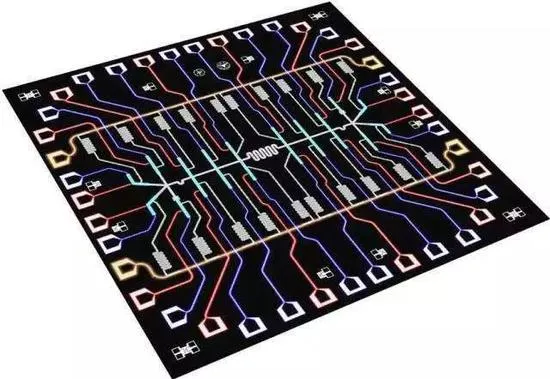 Figure: Quantum chip (processor) with 20 superconducting qubits. Each qubit has control/readout lines; couplers provide switchable interactions.
Refrigeration System
A dilution refrigerator (using a helium‑3/helium‑4 mixture) cools the quantum chip and wiring to near absolute zero—down to ~10 mK or below. Along the signal path, attenuators and filters condition control signals, and shielding reduces external noise to preserve fragile quantum states.
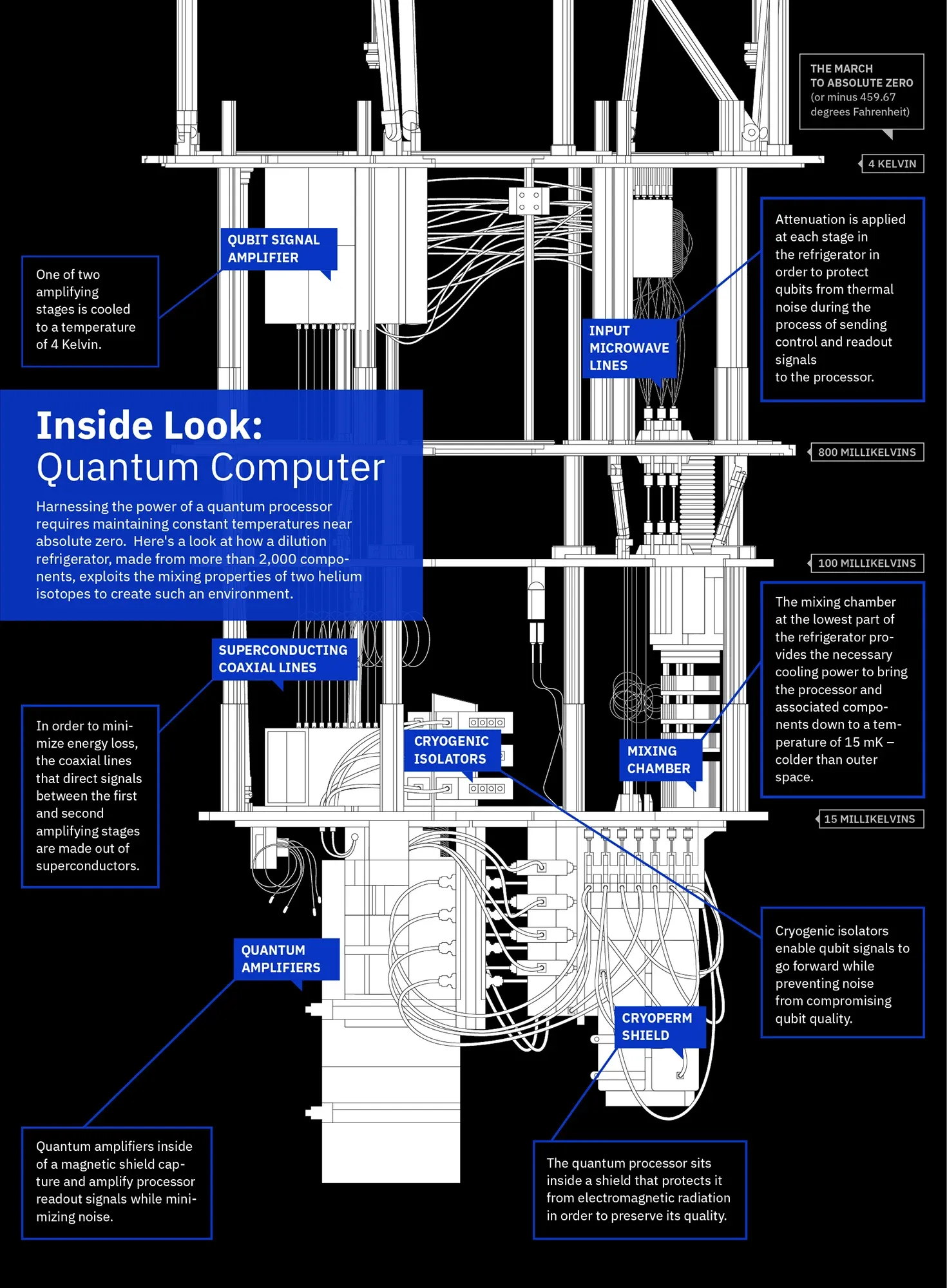 Figure: IBM Q refrigeration stack inside a dilution refrigerator. Coaxial lines handle control/readout; inputs pass through multi‑stage attenuators; outputs use low‑noise amplifiers. Multi‑layer shields block radiation. Temperature steps from room temperature to ~10 mK to stabilize qubits.
Qubit Control System
Converting quantum operation instructions issued by classical computers into high‑precision microwave pulses for driving, manipulating, and reading qubits, typically including devices such as microwave generators, mixers, amplifiers, and isolators.
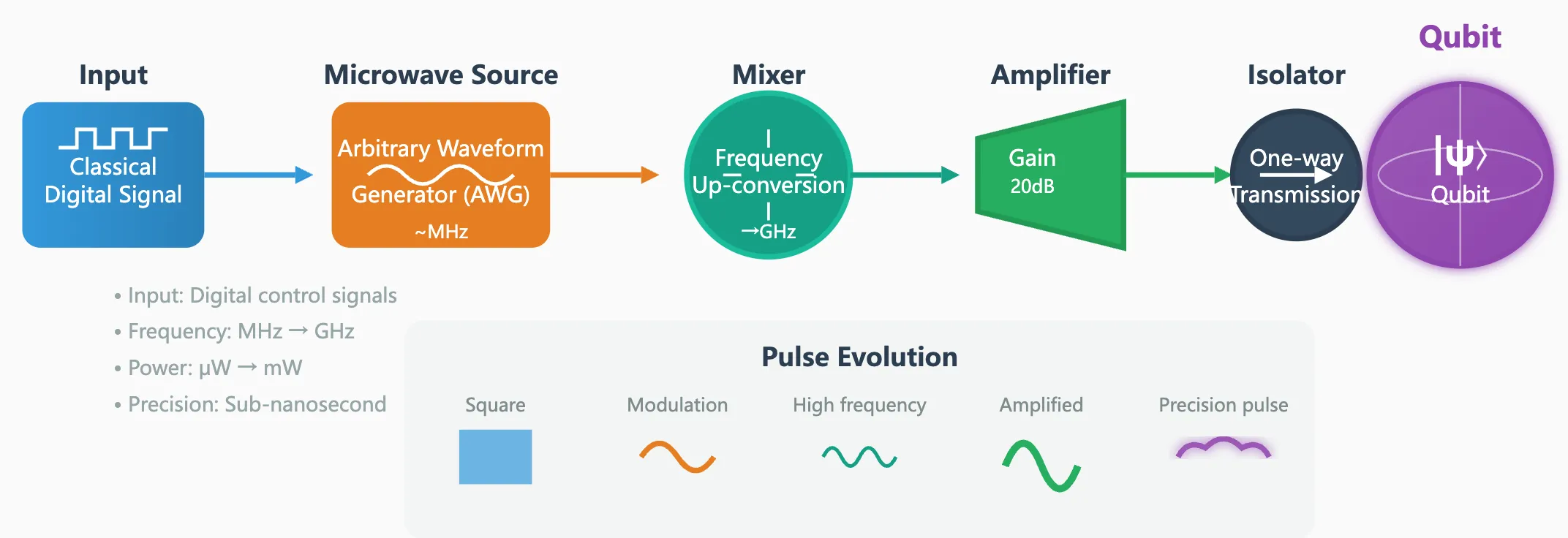 Figure: Qubit control system. Digital commands become precise microwave pulses with high purity and tight timing for accurate state control.
Quantum Error Correction System
Through redundant encoding and real‑time feedback, the system detects and corrects errors caused by decoherence and noise, extending coherence time and improving gate fidelity. For example, the widely used surface code encodes a logical qubit into a two‑dimensional array of qubits and repeatedly measures correlations between neighbors to find and correct errors, prolonging logical‑qubit lifetime when hardware error rates are below threshold.
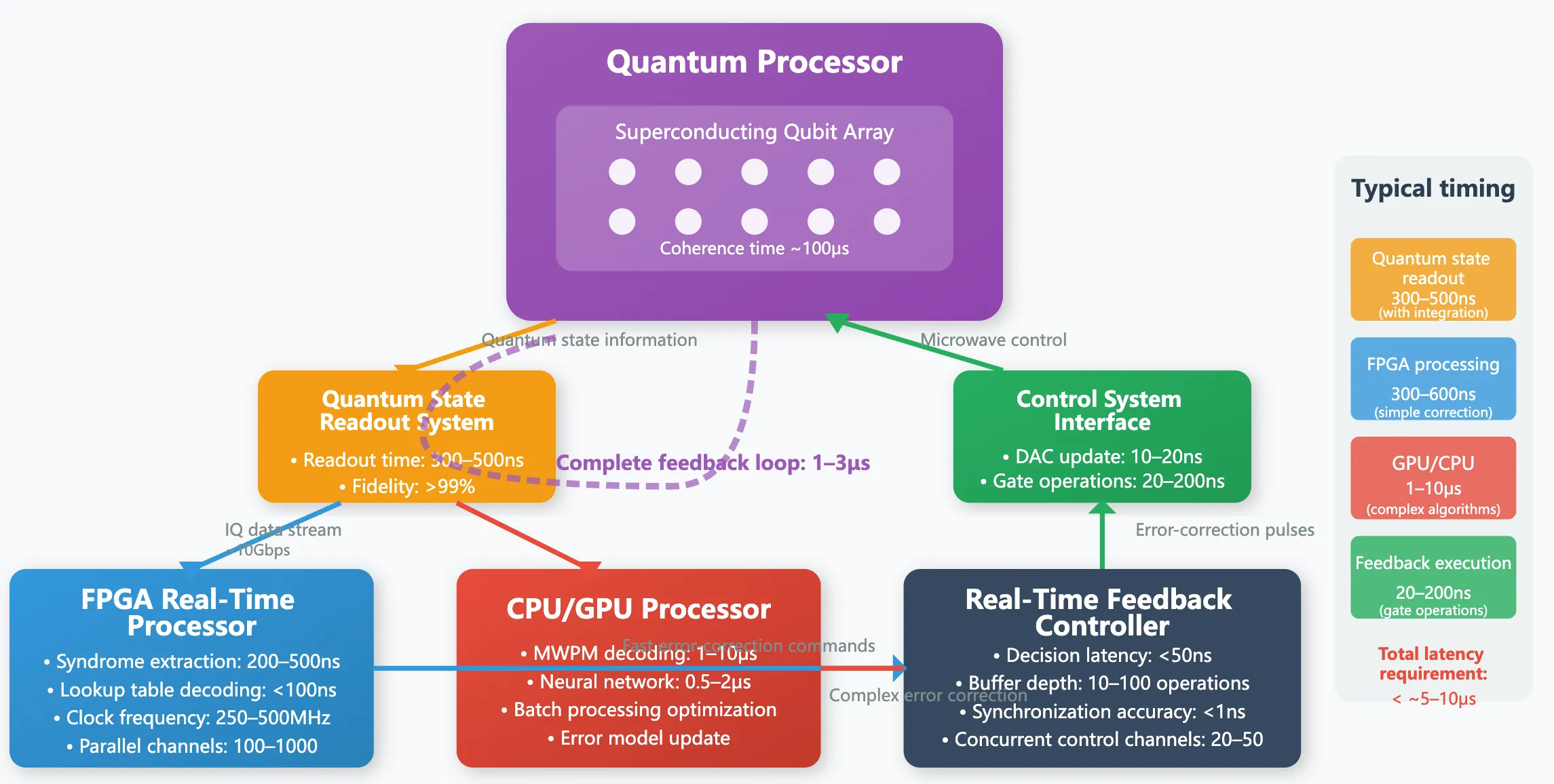 Figure: Quantum error correction loop must run well within coherence time. Low‑latency FPGA plus CPU/GPU compute and tight timing enable real‑time correction.
Overall Architecture
The figure below shows the overall architecture of a quantum computer.
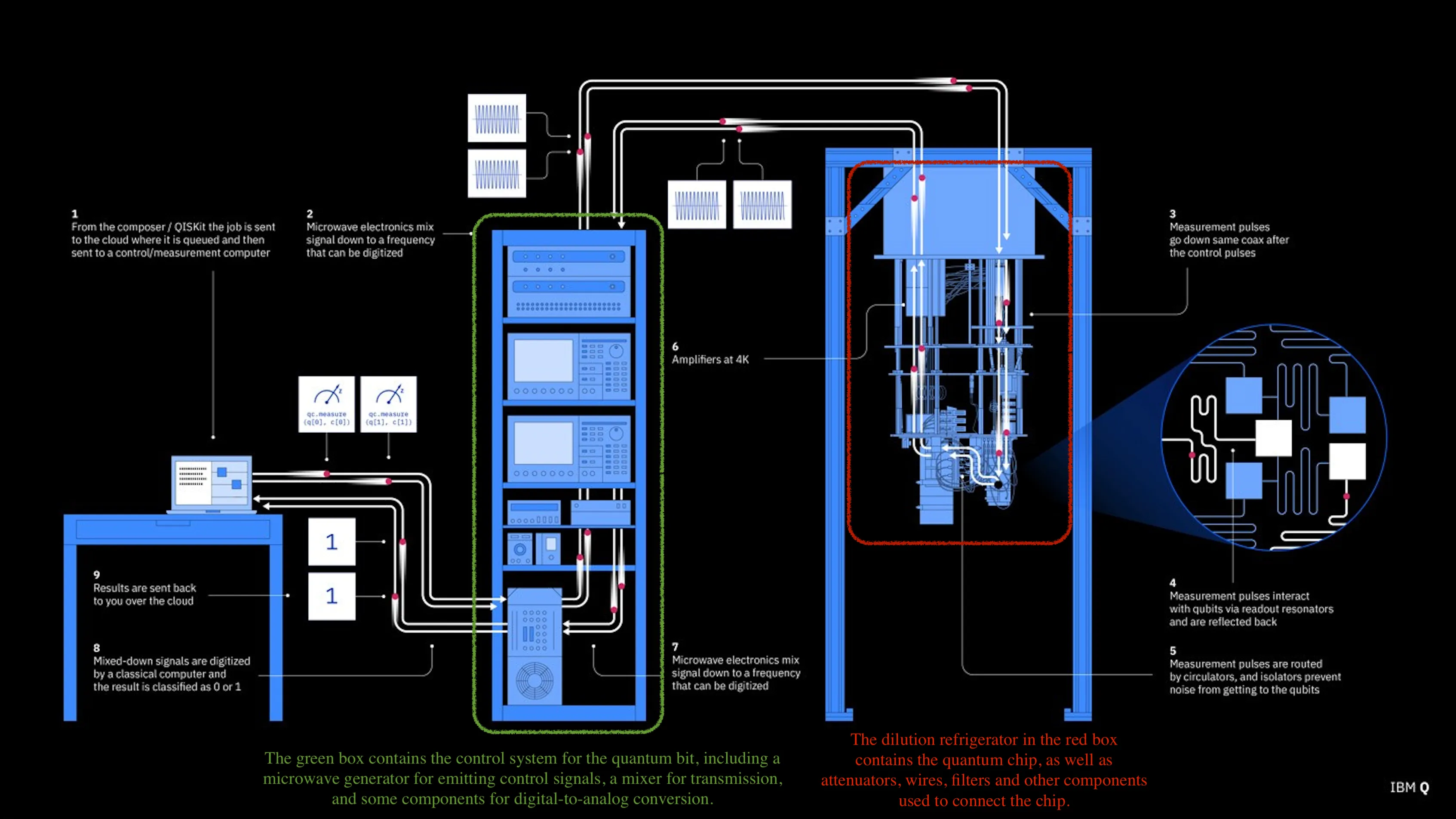 Figure: IBM Q system architecture. Components described above are shown in the figure.
Building Quantum Computers Requires Combining Science and Engineering
The construction of quantum computers is both physics and engineering. Particle-based solutions are purer at the physical level but difficult to implement in engineering; artificial structure-based solutions (especially superconducting qubits) are more scalable in engineering but need to overcome noise and decoherence problems. A complete superconducting quantum computer is essentially a complex combination of quantum chip + dilution refrigerator + control electronics + quantum error correction system. It is both a physical experimental device and a highly engineered system. It is precisely because of this “from physics to system” complete chain that superconducting quantum computers have become the most promising solution to cross the practical threshold first.
References
- Krinner, Sebastian, et al. “Engineering cryogenic setups for 100-qubit scale superconducting circuit systems.” EPJ Quantum Technology 6.1 (2019): 2.
- Kjaergaard, Morten, et al. “Superconducting qubits: Current state of play.” Annual Review of Condensed Matter Physics 11.1 (2020): 369-395.
- Bruzewicz, Colin D., et al. “Trapped-ion quantum computing: Progress and challenges.” Applied physics reviews 6.2 (2019).
- Browaeys, Antoine, and Thierry Lahaye. “Many-body physics with individually controlled Rydberg atoms.” Nature Physics 16.2 (2020): 132-142.
- Burkard, Guido, et al. “Semiconductor spin qubits.” Reviews of Modern Physics 95.2 (2023): 025003.
- Wang, Jianwei, et al. “Integrated photonic quantum technologies.” Nature photonics 14.5 (2020): 273-284.
- Castelvecchi, Davide. “IBM releases first-ever 1,000-qubit quantum chip.” Nature 624.7991 (2023): 238-238.